
Every BC steel building buyer who has been through this before says the same thing afterward: “I wish someone had told me what the foundation was going to cost.” The steel package is the easy part. It is priced, predictable, and shipped from a Nucor plant on a schedule you can plan around. The foundation is the part where your geography meets your wallet.
On a clean rural site in the Okanagan, the foundation might be 12% of your total project cost. On a liquefaction-prone industrial lot in Richmond, the same building’s foundation can run 30% or more – sometimes much more. Here is how to know which kind of site you have, which foundation type fits it, and how to budget honestly.
Why the foundation is where BC steel building budgets blow up
The steel kit is the same price regardless of where you stand it up. The foundation is where geography decides what you actually owe.
Across normal commercial construction, foundations typically represent 10 to 15% of the total project budget. That number holds for a straightforward Okanagan ag site or a clean industrial lot in the Fraser Valley. On difficult BC sites – high seismic hazard, soft soils, deep frost, coastal corrosion conditions – that number climbs into the 20 to 35% range. On the worst sites in Richmond and Delta, the foundation regularly costs more than the steel building itself.
That spread is not a quote error. It is the difference between standing a building on glacial till versus standing it on liquefiable young sand. The variables that drive the range – frost depth, water table, soil bearing capacity, seismic risk, drainage requirements, and site access – get answered by the geotechnical report. Until that report exists, every foundation quote is a guess.
The three foundation types for pre-engineered steel buildings
Most pre-engineered steel buildings in BC sit on one of three foundation systems. Knowing which one your project needs is the difference between an accurate budget and a 30% surprise.
Slab-on-grade with thickened edges
The most common choice for BC warehouses, agricultural buildings, and light industrial projects. A reinforced concrete slab pours directly on prepared subgrade, with thickened perimeter beams and column-line beams that take the column loads. The slab is the floor and the foundation at the same time.
Slab-on-grade is fast, relatively inexpensive, and well-suited to sites with competent surface soils and good drainage. It is the standard answer for most Interior BC projects and many Lower Mainland industrial sites on uplands. It is rarely the right answer in liquefaction zones, on soft fill, or where the building requires a crawl space or basement.
Perimeter wall footings with independent column piers
Continuous strip footings run under the perimeter walls. Isolated piers carry each primary column. The floor slab is poured separately, sometimes later in the schedule.
This system is the default for larger industrial and recreation buildings, especially where column loads are heavy or where the floor slab benefits from being decoupled from the building structure. Perimeter footings give you more design flexibility – you can pour the foundation while waiting on the steel, and the floor slab can include features that complicate slab-on-grade (such as trench drains, equipment pits, or specialized concrete mixes).
Deep pile foundations
When surface soils cannot reliably carry the loads, the foundation skips them entirely. Piles transfer column loads to a deeper, competent soil layer or to bedrock.
Three pile types show up regularly on BC steel building projects. Driven piles – concrete or steel sections hammered into the ground – are the traditional answer in the Lower Mainland and are still common on large industrial projects. Drilled cast-in-place piles are augered and filled with concrete on site; they offer cleaner installation in tight urban sites. Helical piles – also called screw piles – are galvanized steel shafts with helical bearing plates that thread into the ground with a hydraulic motor. Helical piles are increasingly the preferred choice for BC steel buildings because they install year-round, including in frozen ground, and the galvanized finish handles coastal humidity well.
Deep piles cost more than slab-on-grade – sometimes two to three times more – but on sites that require them, they are the only foundation that will pass a structural review.
BC’s three site conditions that change everything
Two factors set BC apart from most North American jurisdictions when it comes to steel building foundations: a wide range of frost depths across regions, and the seismic and liquefaction risk of the Lower Mainland. A third – coastal corrosion – matters on marine sites. Get all three right and your foundation budget holds. Get any of them wrong and the budget moves by tens of thousands of dollars.
Frost depth – how cold your winter is, in millimetres of concrete
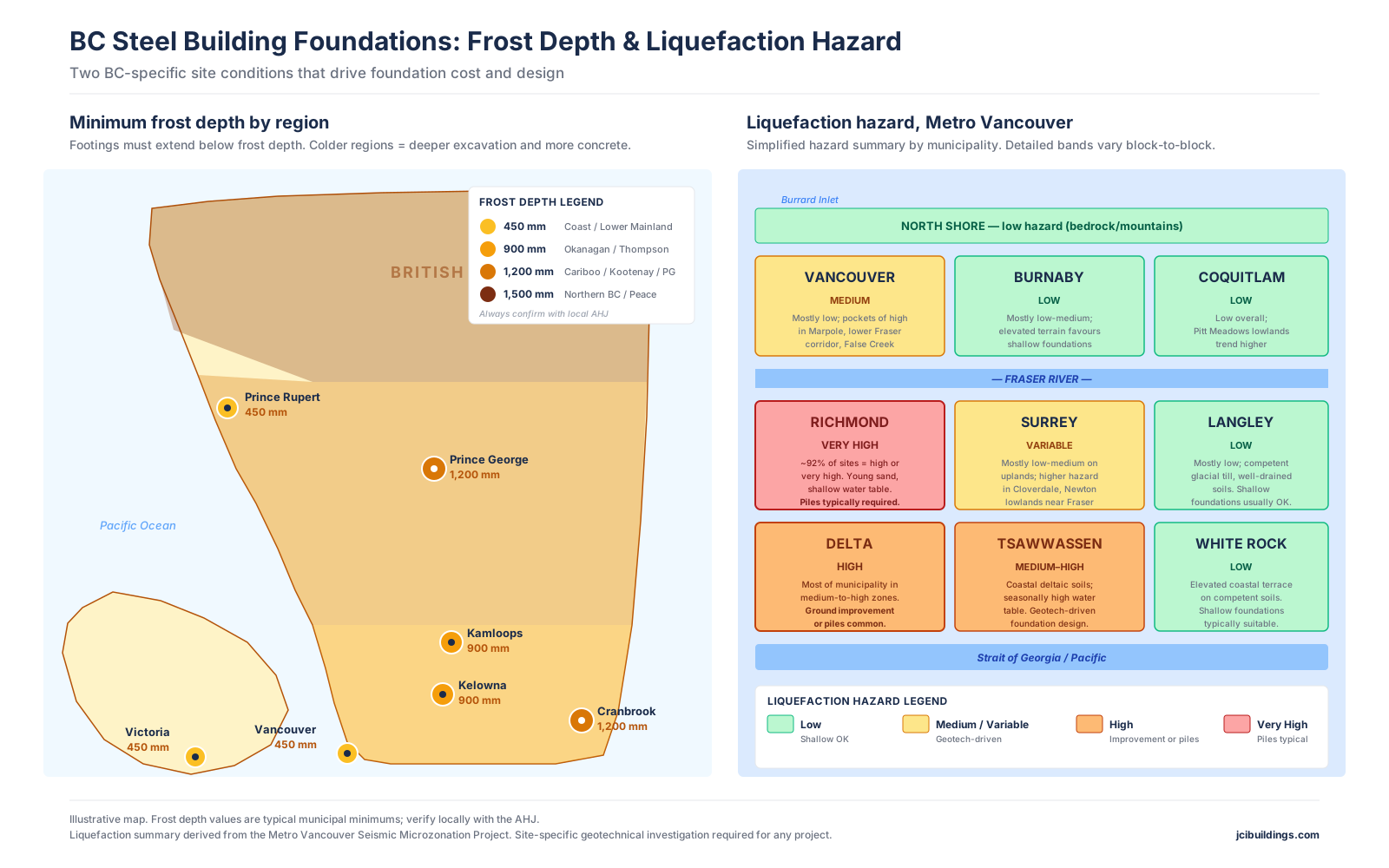
Footings must extend below the frost line. The colder the region, the deeper the footing, the more excavation, and the more concrete you pay for. BC has one of the widest frost-depth ranges in Canada.
Approximate minimum frost depths used by BC municipalities and engineers – confirm locally with the Authority Having Jurisdiction:
In the Lower Mainland, Greater Vancouver, and Greater Victoria, frost depth runs about 450 mm (1.5 feet). This is the most forgiving region in the province. In the Okanagan and Thompson – Kelowna, Penticton, Vernon, Kamloops – frost depth runs about 900 mm (3 feet). In the Cariboo, Kootenay, and around Prince George, frost depth runs about 1,200 mm (4 feet). In Northern BC and the Peace region – Prince George (northern half), Fort St. John, Dawson Creek – frost depth runs 1,200 to 1,500 mm (4 to 5 feet).
A footing in Fort St. John can require three times the excavation and concrete of the same footing in Vancouver. That single fact is one of the biggest reasons identical buildings cost different amounts depending on where they are built. It is also why a quote from an out-of-province kit supplier who has never built in BC’s Interior or North needs careful review before it goes in your budget.
Liquefaction – the Lower Mainland’s invisible foundation tax
In a major earthquake, certain soils – typically young, saturated sands – temporarily lose their strength and behave like a liquid. Buildings sitting on them can tilt, settle, or fail. This is liquefaction, and large parts of the Lower Mainland sit on top of it.
The Metro Vancouver Seismic Microzonation Project, a multi-year mapping effort by BC universities and geotechnical engineers, has documented the hazard in detail. The short version: Richmond is the most liquefaction-prone municipality in Canada. Roughly 92% of Richmond’s developable land sits on high-to-very-high liquefaction hazard soils – young Fraser delta sand with a shallow water table. Delta is in a similar category, with most of the municipality in medium-to-high hazard zones. Pockets of high hazard also show up in South Vancouver and the lower Fraser corridor, including parts of Marpole and the False Creek flats. Steveston, Tsawwassen, Ladner, and parts of New Westminster trend high.
What this means for your foundation: shallow slab-on-grade is rarely an option in those areas. The geotechnical report will typically require ground improvement (stone columns, compaction grouting, deep dynamic compaction) or deep piles that pass through the liquefiable layer into competent soil below. Both add significant cost – and this is the single biggest reason a Richmond or Delta foundation can cost double, sometimes triple, the same building’s foundation 30 kilometres east in Langley.
Burnaby, Coquitlam, Langley, and most of Surrey’s uplands sit on competent glacial till and trend low-hazard. Foundations there usually look like the rest of the province.
Coastal corrosion and high water tables
Sites near salt water – Vancouver Island, the Sunshine Coast, Lower Mainland marine industrial – and sites with seasonally high water tables introduce a third variable: long-term durability of the foundation materials. Galvanized helical piles and corrosion-resistant rebar are the standard answers. They cost more up front, but they preserve the 40-year service life of the steel building above them.
How to choose: a decision framework for BC steel buildings
The right foundation falls out of four questions, answered in order.
First, what does the geotechnical report say about surface soil bearing capacity? If surface soils cannot carry the loads, you are on piles regardless of preference. Second, is the site in a known liquefaction zone? If yes, expect ground improvement or piles. Third, is the project in an Interior or Northern region with significant frost depth? If yes, slab-on-grade with thickened edges still works, but factor the deeper excavation into your budget. Fourth, does the program need a single integrated slab now, or is the floor slab decoupled from the foundation timeline? This drives slab-on-grade versus perimeter footings with a separate slab.
For most BC agricultural and Interior projects, slab-on-grade with thickened edges is the answer. For most Lower Mainland industrial projects on competent uplands, perimeter footings with column piers – or slab-on-grade – works. For Richmond, Delta, and similar high-hazard sites, piles are usually the answer.
The geotechnical report – where every BC foundation starts
This phase is non-negotiable on any commercial steel building project in BC, and it is consistently underbudgeted in both time and money.
A geotechnical report tells you what is under the ground: bearing capacity, soil classification, water table depth, seismic site class, liquefaction risk, and a recommendation for foundation type and depth. Without it, every foundation quote is a guess and every structural drawing is provisional.
Cost depends on site complexity. A straightforward commercial site typically runs $5,000 to $15,000 for the report. Complex sites that require multiple boreholes, lab testing, or ground improvement studies can run $20,000 to $50,000 or more. Major projects on poor soils – large industrial in Richmond, for example – can exceed $100,000. Most BC commercial geotech reports turn around in four to eight weeks from field work to final report. Soft soils, deep foundation studies, or busy seasons push that to ten to twelve weeks.
The biggest mistake on this phase is timing. Geotech findings drive foundation design, which drives foundation cost, which drives the total project budget. If you wait until after design to commission the geotech, you risk redesigning the foundation – and possibly the building – when the report arrives. Engage geotech the same week you sign the design contract.
Drainage, stormwater, and site grading – the foundation costs nobody quotes
Foundation work in BC is rarely just “pour the concrete.” The site has to drain, and municipalities increasingly require stormwater management plans for any new commercial building.
Perimeter drainage – drain rock, weeping tile, and sometimes a sump system – adds 5 to 10% to foundation cost on most sites and is essentially mandatory on Lower Mainland projects. Surface grading and runoff control, required by most BC municipalities for new commercial buildings, can include detention ponds, oil-water separators, and bioswales. Slab vapour barriers are required for any building with heated interior space; they are cheap insurance but skipped often enough to be worth flagging. Rainwater leader connections to on-site retention are an increasingly common Lower Mainland requirement that catches first-time developers off guard.
None of these items break the budget on their own. Together they can add 8 to 12% to the foundation line on a Lower Mainland project.
Three sample BC foundation budgets
To make the abstract numbers concrete, consider the same hypothetical 20,000 sq ft warehouse sited in three different BC locations.
In Vernon, on stable glacial till with no high water table, the foundation is a slab-on-grade with thickened edges and 900 mm frost depth. Foundation cost lands around $8 to $11 per square foot of building footprint. The owner’s surprise is usually how cheap the foundation is compared to what they expected.
In Surrey, on variable but workable soils, the foundation is perimeter footings with column piers and possible spot stabilization where the geotech flags soft pockets. Foundation cost lands around $14 to $20 per square foot. The owner’s surprise is usually the stormwater management requirement.
In Richmond, on high liquefaction hazard with a shallow water table, the foundation requires driven or helical piles to competent stratum, plus ground improvement under the slab. Foundation cost lands around $25 to $40 or more per square foot – sometimes the foundation costs more than the steel building. The owner’s surprise is usually that nobody warned them in the original kit quote.
The buildings above are illustrative composites. Actual budgets vary with geotech findings, scope, and current concrete and pile pricing. For a quote on your specific site, see our steel building cost guide and request a project assessment.
Five foundation mistakes that quietly add 15% to your BC steel building budget
The most common timeline-and-budget killers we see on the foundation side:
- Commissioning the geotechnical report after design has started. Late geotech means foundation redesign – and sometimes building redesign.
- Assuming a Vancouver-area foundation cost will hold in Kelowna or Prince George. Frost depth alone can change the number meaningfully.
- Skipping perimeter drainage on Lower Mainland sites. A slab that “works” without drainage in year one fails in year five.
- Buying a steel building kit before having a foundation plan. Anchor bolt patterns and column loads need to match. Out-of-province kits sometimes need re-engineering for BC seismic loads.
- Underestimating ground improvement on liquefaction sites. Stone columns, deep dynamic compaction, and helical piles add real dollars. Find out early.
How JCI Buildings approaches foundations in BC
JCI Buildings has been delivering pre-engineered steel buildings across British Columbia for decades. We work with BC-based geotechnical and civil engineers from project start, so the foundation is designed to match the actual site – not a template. We have built across every region referenced in this article: Lower Mainland industrial, Okanagan ag, Thompson commercial, Kootenay warehouses, and Northern BC industrial.
Our design services team will walk a prospective buyer through realistic foundation cost ranges for their specific site before any structural design is committed. If you want a realistic foundation budget for your project – not a kit-quote number that ignores your site – talk to our BC team.
Frequently asked questions
How much does a steel building foundation cost in BC?
Foundation cost in BC runs roughly $8 to $40+ per square foot of building footprint, depending on site conditions. Clean Interior sites land at the low end; high-liquefaction sites in Richmond or Delta land at the top. Most commercial foundations represent 10 to 35% of total project cost.
Do I need piles in Richmond or Delta?
Usually yes. Roughly 92% of Richmond’s developable land sits on high or very high liquefaction hazard soils, and most of Delta is in medium-to-high hazard zones. The geotechnical report typically requires deep piles or ground improvement; shallow slab-on-grade is rarely accepted.
What is the frost depth for foundations in Vancouver, Kelowna, and Prince George?
Approximate minimum frost depths used in BC are 450 mm in Vancouver and the Lower Mainland, 900 mm in Kelowna and the Okanagan, and 1,200 mm or more in Prince George and the Cariboo. Always confirm with the local Authority Having Jurisdiction before pricing.
Can I pour a steel building foundation in winter in BC?
In the Lower Mainland and on the Coast, yes – with cold-weather measures such as insulated blankets and accelerated concrete mixes. In the Okanagan and Thompson, foundation pours typically pause from December to February. In Northern BC, the season closes for eight to twelve weeks. Helical piles install year-round, including in frozen ground.
What is the cheapest foundation type for a pre-engineered steel building?
Slab-on-grade with thickened edges is the cheapest option for most BC sites – typically $8 to $14 per square foot on a clean Interior or Lower Mainland upland site. It is only suitable where surface soils are competent and the site drains well. On liquefaction sites or sites with soft fill, slab-on-grade is not an option.
How long does a geotechnical report take in BC?
Most BC commercial geotechnical reports take four to eight weeks from field work to final report. Complex sites – soft soils, deep foundation studies, or sites requiring ground improvement analysis – can take ten to twelve weeks. Engage geotech early, ideally the same week design begins.
Are helical piles a good choice for steel buildings in BC?
Often, yes. Helical piles install year-round, including in frozen ground, suit BC’s coastal corrosion conditions well when galvanized, and avoid the cure time of cast-in-place concrete. They are increasingly the default choice for BC steel building projects on soft or seasonally wet sites.
What is liquefaction, and does it affect my foundation?
Liquefaction is what happens when saturated soils – typically young sand – temporarily lose strength during an earthquake. Affected buildings can tilt or settle. In BC, liquefaction risk is concentrated in the Lower Mainland, especially Richmond, Delta, and the lower Fraser corridor. It almost always changes foundation design and cost.
